



PLENARY TALKS
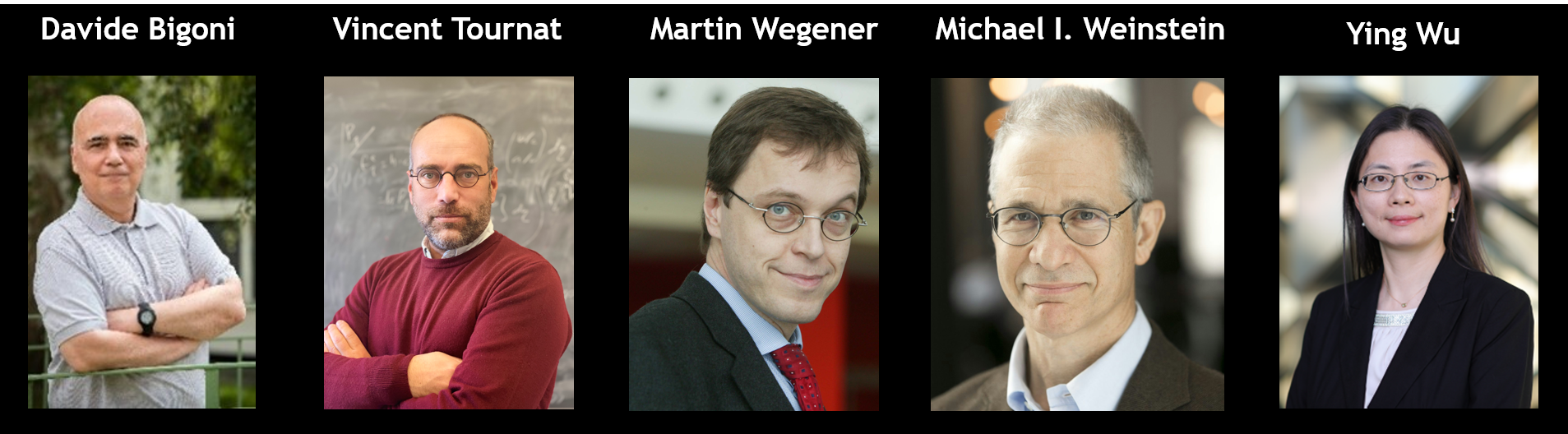
Davide Bigoni on “Shearing, folding, and vibrating solids and structures”
Abstract: During the process of folding, curvature localizes in space and progressively forms sharp edges, separated by almost undeformed elements. Origami is created by inducing folding in thin films, which can be made from paper or other materials. Differently from the creation of origami, folding in nature is a spontaneous process. Modelling of spontaneous folding is addressed in structures and solids. Similarly, during the emergence of deformation bands, strain localizes, to create stress channelling and wave trapping. A new homogenization scheme shows that a metamaterial can be designed to exhibit shear banding, followed by restabilization and final ellipticity loss.
Biography: Davide Bigoni graduated from the University of Bologna (Italy), where he completed his Ph.D. in 1991 under the supervision of Professor T. Hueckel (Duke University, USA). He began his academic career as an Assistant Professor at the University of Bologna and, in 1999, became an Associate Professor at the University of Trento (Italy). Since 2001, Professor Bigoni has held a Full Professor position at the University of Trento, where he leads a dynamic research group specializing in Solid and Structural Mechanics. His recognitions include being elected a Euromech Fellow by the European Mechanics Society in 2009, receiving the Ceramic Technology Transfer Day Award in 2012, and being awarded a Doctor Honoris Causa by Ovidius University of Constanta in 2014. Additionally, he has been honored with the Panetti and Ferrari Award for Applied Mechanics by the Accademia delle Scienze di Torino. His contributions extend globally: he was the Guest Lecturer for the Midwest Mechanics Seminars in 2018, elected a Fellow of the Istituto Lombardo, Accademia di Scienze e Lettere in 2019, and featured in a 60th Anniversary Issue of the Journal of the Mechanics and Physics of Solids. In 2024, he was inducted as a Fellow of the Italian Academy of Engineering. Professor Bigoni’s research is prominently featured on the covers of nine international journals. He has played a key role in fostering academia-industry collaboration, coordinating three European grants and a Marie Curie Fellowship. He is the recipient of two prestigious ERC Advanced Grants from the European Research Council (2013, 2021). More details can be found at https://bigoni.dicam.unitn.it/
——————————————————————————————————————————————————————
Vincent Tournat on “Waves in Multistable Mechanical Metamaterials”
Abstract: Multistable metamaterials, composed for example of bistable mechanical units elastically coupled to their nearest neighbors, have recently been conceived in diverse ways, particularly within the family of flexible mechanical metamaterial architectures. Such multistable metamaterials can support progressive fronts, also called transition waves, switching sequentially its multistable units front one equilibrium to another, and resulting in the local or global reconfiguration of the medium. In addition, these nonlinear metamaterials are also known to support a rich variety of nonlinear waves, as vector solitons, breathers, cnoidal waves, among others. In this presentation, I will highlight the fundamentals and a selection of recent results on transition waves triggering, propagation, and discuss some of their potential applications. In general, these reconfiguration fronts obey nonlinear reaction-diffusion equations and show specific properties not necessarily found in other waves supported by periodic and/or nonlinear media, e.g., strong nonreciprocity, robustness, extreme amplitude dependent behavior… They can consequently be implemented for applications involving local or global reconfiguration of a medium, manipulating mechanical memory, controlling waves in space and time, mechanical computing or be the vector for material embedded intelligence.
Biography:Vincent Tournat currently holds a Research Professor position at CNRS and conducts research in the field of nonlinear waves and metamaterials at the Laboratory of Acoustics at Le Mans University in France. VT graduated with a major in solid state physics, acoustics & wave physics and defended his PhD thesis on nonlinear acoustics in granular materials in 2003. He then spent the year 2004 as a postdoc at Hokkaido University, Japan, working on laser picosecond ultrasonics, prior to starting at CNRS. During his first years at CNRS, he established two research groups on acoustics of granular media and laser ultrasonics, then participated in developing two other areas of research in his department, ultrasonic non-destructive testing, and acoustic metamaterials. For the last decade, his research focuses on nonlinear waves in flexible mechanical metamaterials. From 2007 to 2022, VT led the “Acoustics and Mechanics of Materials” research team of more than 50 people. His research achievements have been awarded prizes on several occasions, including the CNRS Bronze Medal in 2010 and the Silver Whistle early career award by the International Commission on Ultrasonics (ICU) in 2013. Until 2024, he has been the director of the Institut d’Acoustique – Graduate School (http://iags.univ-lemans.fr) created in 2017 and awarded the national label “Graduate School” (a selection of few Institutes comprising high impact research laboratories, departments, as well as recognized master, engineering and doctoral curriculae). VT has been regularly invited for research visits in Japan, Chile, Spain, USA and he is a visiting research Professor at Harvard University since September 2022. https://perso.univ-lemans.fr/~vtournat/
————————————————————————————————————————————————————————-
Martin Wegener on “Nonlocality as a design tool in wave-tape and diffusion-type metamaterials”
Abstract: We review our theoretical and experimental work on using nonlocal interactions in metamaterials as a design tool to engineer targeted dynamic and static behavior in wave-type systems as well as in diffusion-type systems. For example, nonlocality allows to achieve large characteristic lengths connected with anomalous size effects in elasticity beyond Cauchy elasticity. Designed nonlocal interactions can also lead to any wanted nonlocal diffusivity (or conductivity) in, e.g., static and dynamic charge flow, fluid flow, and the flow of thermal energy (thermal conduction).
Biography: After completing his Diplom and PhD in physics at Johann Wolfgang Goethe-Universität Frankfurt (Germany) in 1986 and 1987, respectively, he spent two years as a postdoc at AT&T Bell Laboratories in Holmdel (U.S.A.). From 1990-1995 he was professor (C3) at Universität Dortmund (Germany), since 1995 he is professor (C4, later W3) at Institute of Applied Physics of Karlsruhe Institute of Technology (KIT). Since 2001 he has a joint appointment as department head at Institute of Nanotechnology (INT) of KIT, from 2016-2022 he was one of three directors at INT. From 2001-2014 he was the coordinator of the DFG-Center for Functional Nanostructures (CFN) at KIT. Since 2018 he is spokesperson of the Cluster of Excellence 3D Matter Made to Order. His research interests comprise ultrafast optics, (extreme) nonlinear optics, optical laser lithography, photonic crystals, optical, mechanical, electronic, and thermodynamic metamaterials, as well as transformation physics. This research has led to various awards and honors, among which are the Alfried Krupp von Bohlen und Halbach Research Award 1993, the Baden-Württemberg Teaching Award 1998, the DFG Gottfried Wilhelm Leibniz Award 2000, the European Union René Descartes Prize 2005, the Baden-Württemberg Research Award 2005, the Carl Zeiss Research Award 2006, the Hector Research Award 2008, the SPIE Prism Award 2014 for the start-up company Nanoscribe GmbH, the Stifterverband Science Award – Erwin-Schrödinger Prize 2016, and the Technology Transfer Prize of the German Physical Society (DPG) 2018. In 2014, 2015, 2016, 2017, 2018, 2020, and 2021 Clarivate Analytics listed him as “Highly Cited Researcher” (top 1%). He is Member of Leopoldina, the German Academy of Sciences (since 2006), Member of acatech, the National Academy of Science and Engineering (since 2019), Member of the Hector Fellow Academy (since 2013, President from 2016-2022), Fellow of the Max Planck School of Photonics (since 2019), Fellow of the Optical Society of America (since 2008), and Honorary Professor at Huazhong University of Science & Technology, Wuhan, China (since 2014).
——————————————————————————————————————————-
Michael I. Weinstein on “Quantum tunneling and its complete suppression in strongly magnetic systems”
Abstract: In the absence of a magnetic field, a quantum particle always tunnels from one well into a neighboring well through a “classically forbidden” region at a rate which is the reciprocal of the “eigenvalue splitting”. Magnetic systems give rise to entirely new tunneling phenomena. We construct a family of double well potentials containing examples for which quantum tunneling is completely eliminated. On the other hand, magnetic tunneling does occur for **typical** double-well potentials, and we prove an upper bound on its tunneling rate. This is joint work with C.L. Fefferman and J. Shapiro.
Biography: Michael Weinstein is on the faculty at Columbia University as a Professor of Applied Mathematics in the Department of Applied Physics and Applied Mathematics, and a Professor of Mathematics in the Department of Mathematics. He received his Ph.D. from the Courant Institute at New York University in 1982 under the direction of George C. Papanicolaou, and was a postdoctoral fellow at Stanford University (1982–1984) with Joseph B. Keller. From 1984 to 1988, he was Assistant Professor of Mathematics at Princeton University. In 1988, he joined the mathematics faculty at the University of Michigan-Ann Arbor as an Associate Professor (1988–1992), and then Full Professor (1992–2000). Weinstein was a Member of Technical Staff at Bell Laboratories / Lucent Technologies in the Fundamental Mathematics Research Group from 1998–2004. In 2004, he joined the faculty of Columbia University. Weinstein is a SIAM Fellow (Society of Industrial and Applied Mathematics) and a Fellow of the American Mathematical Society. He was awarded the Martin Kruskal Prize by SIAM (2018) for his contributions to fundamental and applied aspects of nonlinear waves and coherent structures. He has been a Simons Foundation Math + X Investigator since 2015. In 2025, Weinstein was elected to the American Academy of Arts and Sciences.
————————————————————————————————————————————————————————-
Ying Wu on “Effective medium theories and their applications in metamaterials”
Abstract: Effective medium theories, or homogenization, are fundamental tools in the study of wave propagation and the design of metamaterials. By replacing a complex heterogeneous medium with an equivalent homogeneous one, effective theories not
only simplify the mathematical description of wave phenomena but also provide physical insight and practical guidelines for engineering metamaterial structures. Over the years, different theoretical frameworks have been developed. In this talk, I will review our contributions to effective medium theories derived from several complementary approaches, including the coherent potential approximation, multiple-scattering theory, and Green’s function formalism. Each of these methods captures different aspects of wave interactions and reveals distinct regimes of validity. Building on these foundations, I will showcase how such effective descriptions can be employed in the design of advanced metamaterials, with emphasis on double-zero-index materials and space-coiling based Mie-resonator materials. Finally, I will highlight applications where these designs enable novel functionalities, such as wavefront shaping, enhanced emission, and broadband absorption, demonstrating the broad impact of effective medium theories in both fundamental studies and practical wave-control technologies.
Biography: Ying Wu is Professor and Chair of Applied Mathematics and Computational Science (AMCS) at King Abdullah University of Science and Technology (KAUST). Her research focuses on the theoretical and numerical modeling of metamaterials, with expertise spanning homogenization, coupled-mode theory, perturbation methods, and multiple
scattering. She received the Young Investigator Award from the International Phononics Society (IPS) in 2017 and has served on the IPS Board since 2021.